Showing posts with label GTG. Show all posts

Saturday, January 24, 2026

Green-top Guidelines Links

Continue Reading

Tuesday, February 14, 2023

Starting Point for MRCOG Part 2


A road starting and leading to success of MRCOG
www.rubabk4course.com/courses

This blog post is especially for those who are at the very beginning of their preparation for MRCOG part 2. If you have already decided to go 4 MRCOG and want to start off your journey towards your goal, then this post might be useful.

You will find many great pieces of advice about exam preparation on the internet. I have tried to provide an outline for the exam and an essential reading materials list so that you will have an idea of what to collect and how to start the preparation. Please keep in mind that the information given in this post is not ultimate & comprehensive. You must add more to it whenever you come across relevant stuff.


Starting Point 

The starting point for your preparation is to spend some time on the MRCOG part 2 section on the  RCOG website. Most of the information I am about to share is taken and summarised from the RCOG website.
MRCOG part 2 is a written exam that assesses basic clinical knowledge and its application at a level of UK ST5 trainee in obstetrics & gynaecology as defined in the RCOG curriculum.
You need to plan well ahead of time as you are required to fulfil some prerequisites before you can sit for the exam. There is a time limit and frame to take the exam after part 1. (Please visit the RCOG website for updated information)

Assessment of training

From August 2019, the Assessment of Training (AoT) will be a requirement for entry to the Part 3 MRCOG exam.
Candidates will no longer need to complete AoT before taking Part 2 MRCOG exam.
For the latest updates, kindly visit the following links:

Exam Calendar
MROCG Part 2 is conducted two times per year in January & July at various locations across the globe.

Exam Format 
A computer-based written exam consisting of two papers covering different modules.
Continue Reading

Wednesday, November 10, 2021

GTG 8 Amniocentesis and Chorionic Villous Sampling

This blog post is a Summary of Green Top Guideline 8: Amniocentesis and Chorionic Villous Sampling which was updated in October 2021. As it is a GTG so, it is must to go through the full guideline by yourself in order to have the complete understanding. 


To download the guideline: Click Here

For Infographic: Click Here

For All GTGs: Click Here


RK4 Courses

Background

  • Prenatal diagnosis in the form on amniocentesis or CVS is offered due to various reasons such as higher risk for aneuploidy screening, suspected structural anomaly or in cases of known risk of inherited genetic disease
  • The only definitive diagnostic tests both CVS & amniocentesis
  • CVS done between 11+0 - 13+6 wks Can also be done 14+0 - 14+6 wks 
  • Amniocentesis offered from 15+0 wks 
  • Individualised counselling
  • Informed written consent Form 3
  • Must provide information for aftercare


Organising amniocentesis & CVS

  • Women are usually anxious so should support them ± partners
  • Follow Fetal Anomaly Screening Program guidance
  • Appropriate environment, skilled staff, access to allied specialities and appropriate support for continuation or termination of pregnancy
  • Sensitive & unbiased approach
  • Discuss religious aspects
  • Give time to discuss the decision with partners & friends


Additional Risks with Invasive Testing

Risk of Miscarriage

  • Additional risk of pregnancy loss after CVS or Amniocentesis is performed by an appropriately trained operator is < 0.5%

Different studies have been quoted

  • Earlier studies showed increased pregnancy loss after CVS, but later studies show that there is no significant increase in pregnancy loss above the background risk with both procedures
  • Lower pregnancy loss likely due to improvements in technology, techniques & experience

Systemic Review 2000-2014

  • Procedure-related risk of pregnancy loss Amniocentesis 0.11% CVS 0.22% Both 0.35%

Cochrane Review comparing route for CVS (Transabdominal or Transcervical)

  • Pregnancy loss below background rate regardless of route
  • Procedure-related pregnancy loss Transcervical 1.4% Transabdominal 1%

Other risks

  • CVS results may be affected by placental mosaicism in 1-2% 
  • Structural anomaly present Discuss ongoing care (continuation or termination of pregnancy)
  • Structural anomaly absent & QFPCR after CVS suggest chromosomal anomaly full karyotype awaited before any decision 
  • Severe maternal sepsis very rare
Continue Reading

Sunday, March 14, 2021

GTG 69 NVP & Hyperemesis Gravidarum

This is the summary of GTG -69 Hyperemesis Gravidarum released in 2016. This is one of a frequently tested guideline in the exam. Nausea and vomiting of pregnancy is one the most common indication for admission with typical stay of 3-4 days in the Hopsital. Hyperemesis Gravidarum is the severe form of NVP which can adversely affect the QoL and has a high recurrence in next pregnancy. 

I hope this post is helpful. Suggestions to improve future posts are welcome.

Thanks


To download the full GTG 69 Click Here

All GTGs links Click Here


GTG 69 Hyperemesis Gravidarum

Epidemiology

NVP symptoms of nausea ± vomiting during early pregnancy where no other causes 80%

HG severe form of NVP 0.3-3.6%

Recurrence 15%-80% 

  • Reduced if change in paternity in second pregnancy 10.9%

Diagnosis of NVP & HG


NVP diagnosis  ONLY when onset in 1st trimester + other causes excluded 

  • If after 10+6 wk consider other causes 
  • Typically starts 4-7th wk Peaks 9th wk Resolves by 20 wk in 90%

HG diagnosis Protracted NVP with triad of >5% pre-pregnancy weight loss, dehydration & electrolyte imbalance


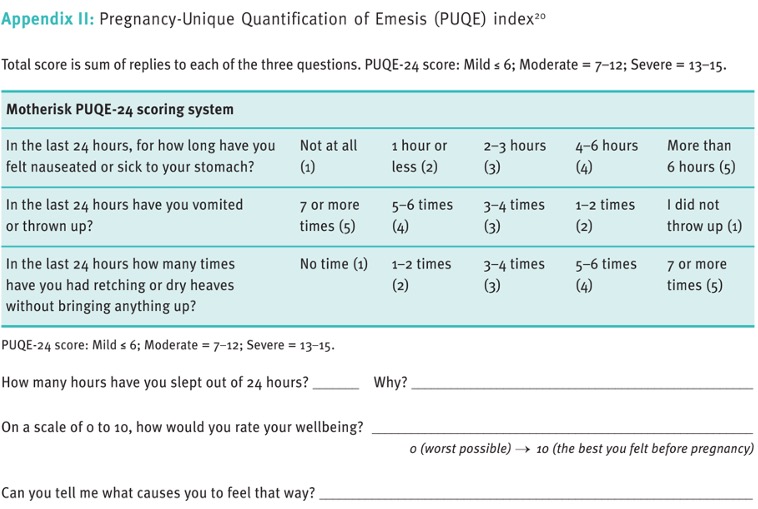
Severity NVP classify Objective & validated index of N & V PUQE Pregnancy Unique Quantification of Emesis


Initial clinical assessment & baseline investigations

  • Features in history, examination & investigations to asses & diagnose NVP and HG for monitoring of the severity
Continue Reading

Monday, October 05, 2020

GTG# 38 Management of Gestational Trophoblastic Disease

This post is the summary of green-top guideline GTG 38 “Management of Gestational Trophoblastic Disease” which was published in September 2020.  The new version of the guideline has some changes, so it is important to cover it. There are some important numbers which are tested repeatedly in exams. It is strongly encouraged to go through the original guideline to make sure that no point is missed. 

I hope this post is helpful. Suggestions to improve future posts are welcome.

To Download the Guideline 38: Click Here

All GreenTop Guidelines: Click Here


GTG 38 gestational trophoblastic disease


Definitions

Gestational trophoblastic disease (GTD) is a group of disorders ranging from premalignant (complete & partial mole also called hydatidiform mole) to malignant (invasive mole, choriocarcinoma, placental site specific trophoblastic tumour (PSTT) and epithelium trophoblastic tumour (ETT)

Gestational trophoblastic neoplasia (GTN): persistence of GTD after primary treatment (persistent elevation of HCG)

Histological confirmation for diagnosis

  • Required for complete/partial mole
  • Not required for GTN

Introduction & Background

Molar pregnancy subdivided into complete and partial mole 

Complete Mole

Partial Mole

Diploid & androgenic in origin

Triploid 90%

Tetraploid or mosaic occasionally

No fetal tissue

Fetus or fetal RBCs present

75-80% arise due to duplication of single sperm after fertilisation of an ‘empty’ ovum

2 sets of paternal haploid & 1 set of maternal haploid chromosomes 

20-25% due to dispermic fertilization of an ‘empty ovum’

Not all triploid or tetraploid pregnancies are partial moles

Must have histopathological evidence of trophoblast hyperplasia for dx

GTD (Hydatidiform mole, Invasive mole, Choriocarcinoma, PSTT)

  • Uncommon in UK
  • Incidence 1 in 714 live births
  • Ethnic variation Asian 1 in 387 live births Non-Asian 1 in 752 live births
  • Associated with age at conception, higher in extremes of age
    • <15 yrs 1 in 500 pregnancies >50 yrs 1 in 8 pregnancies 

GTN 

  • May develop after molar/non-molar pregnancy or a live birth
  • 1 in 50 000 after live birth 
  • On average, a consultant O &G will deal with one new case every 2 years

Registration & Treatment Program UK

  • Effective with cure rates of 98-100% 
  • Chemotherapy Needed in 
    • 0.5-1.0% after partial mole 
    • 13-16% after complete mole
  • Registration with GTD is a minimum standard of care

Presentation of Molar Pregnancy

  • Most common presentation is irregular vaginal bleeding (60%), positive pregnancy test & supporting USG evidence (12%)
  • Less common hyperemesis, excessive uterine enlargement, hyperthyroidism, early-onset pre-eclampsia (PET) & abdominal dissension due to theca lutein cysts
  • Very rarely: haemoptysis or seizures— metastasis in lungs or brain

Role of USG

  • USG use has lead to earlier diagnosis of molar. Reduction in mean gestation age of diagnosis from 16 to 9 weeks (over 1988- 2013)
  • Majority of histologically proven molar associated with USG diagnosis of delayed miscarriage or an-embryonic pregnancy
  • Pre-removal accuracy of diagnosis increases with gestational age 
    • 35-40% before 14wks
    • 60% after 14 wks 
  • USG correctly identified 56% of molar pregnancies with suspected missed miscarriage
  • Unrecognised GTD prior to removal 2.7%
Continue Reading

Tuesday, June 02, 2020

GTG # 26 Assisted Vaginal Birth


Operative vaginal delivery guideline rcog latest


This post is the summary of GTG #26 Assisted Vaginal Birth which was released in April 2020. This guideline has been update in detail with few recommendations which are different from previous version.
In this post, important points from the guideline (which could be tested in exam) are extracted. It is strongly recommended to read the original document to develop deep understanding of this guideline.
I hope this summary is helpful. 
Your feedback and suggestions to improve future posts are welcome. 


Thanks 
To download the guideline : Click Here

ASSISTED VAGINAL BIRTH

Introduction

  • Incidence of Assisted Vaginal Birth (AVB) in UK 10-15%
  • 1:3 Nulliparous deliver by vacuum or forceps

Preparation for assisted vaginal birth (AVB)

Avoiding AVB

Factors which can reduce the need
  • Continuous support during labour specially when carer is not a staff member 
  • If not using epidural adopt upright or lateral position in 2nd stage of labour
  • With low-dose epidural 6% absolute in chance of spontaneous vaginal birth if lying down vs upright in 2nd stage 
  • Delayed pushing for 1-2 hrs recommended in nulliparous with epidural ( rotational/ mid pelvic AVB)
Factors which can increase the need
  • Epidural analgesia although less likely with newer techniques
No effect
  • Epidural either in latent phase or active phase
  • Discontinuing epidural analgesia during pushing No incidence of AVB, but woman's pain  (22% vs 6%)
Insufficient evidence to recommend for reducing incidence of AVB
  • Any particular regional analgesia technique
  • Routine oxytocin augmentation for women with epidural
  • Routine prophylactic manual rotation of fetal malposition in 2nd stage of labour
  • Different studies:
    • Manual rotation 90% success rate with in operative birth. Also duration of 2nd stage 
    • If corrected fetal malposition by manual rotation in early 2nd stage no difference in rate of AVB
    • Larger RCTs are needed
Defining AVB
  • Use standard classification system Table 1 and perform systematic abdominal & vaginal examination
Continue Reading

Wednesday, June 26, 2019

Obesity in Pregnancy —(GTG # 72)

different women with increasing BMI obese in pregnancy ROCG gtg 72

This blog post is a summary of GTG guideline # 72 published in November 2018.
Obesity in pregnancy is associated with risks to both mother and fetus. The points in this post are exclusively summarized from latest guideline and some additional points from various sources. GTGs are a must for the exam. It is strongly recommended to go through the original document which is available free on the RCOG website.

GTG # 72 Care of Women with Obesity in Pregnancy
Introduction 
  • Obesity is increasing in UK population 9-10% in 1990s : 16-19% in 2000s
  • One of the most commonly occurring risk factor in obstetrics 
  • Pregnancy:
    • Normal BMI 47%
    • Obese 21%
Classification of adults according to BMI (Source GTG)
Classification
BMI (kg/m2)
Underweight
< 18.50
Normal range
18.50–24.99
Overweight
≥ 25.00
Preobese
25.00–29.99
Obese class I
30.00–34.99
Obese class II
35.00–39.99
Obese class III
≥ 40.00


Risks of Obesity
Mother
Fetus 
Miscarriage
Gestational Diabetes (GDM)
Hypertensive Disorders (PIH/PET)
Venous Thromboembolism (VTE/PE)
Induced Labour (IOL)
Dysfunctional or Prolonged Labour
Cesarean Section
Anaeesthetic Complications
PPH
Fetal monitoring challenging 
Difficulty in breastfeeding (both initiation & maintenance)
Congenital anomalies
Prematurity
Still Birth
Macrosomia
Neonatal Deaths
Increased Obesity/ Metabolic disorders in childhood

  • High pre-pregnancy BMI associated with small but statistically significant increase in severe maternal morbidity and mortality
  • MBRRACE-UK 2015
    • 30% of women who died were obese
    • 22% women were overweight
  • CEMACH 2003-5 recommended: women with BMI ≥30 kg/m2 should have prepregnancy counseling
Pre-pregnancy care
Primary care settings
  • Should ensure to optimize weight before pregnancy in women of childbearing age
  • Advice on weight and lifestyle during preconception counseling or contraceptive consultation 
  • Measure weight and BMI
  • Weight loss in between pregnancies reduces stillbirth, hypertensive disorders / macrosomia and improves chances of VBAC
  • BMI ≥30 kg/m2 
    • advised to take folic acid (5mg), starting at least one month before conception and continue till 1st trimester because of risk of NTD
  • BMI ≥27 kg/m2 
    • less likely to use nutritional supplement/folate in diet 
    • folate levels are low even after controlling folate intake
  • Vitamin D
    • Prepregnancy BMI is inversely associated with serum Vit-D in pregnant women
    • BMI ≥30 kg/m2
      • d risk of Vit-D deficiency
      • cord serum Vit-D levels lower
    • In UK women at risk of Vit-D deficiency 
    • 1/4 aged 19-24 yrs 1/6 aged 25-34 yrs
    • Vit-D supplements in single continued dose serum 25-hydroxyvitamin D at term and may reduce risk of low birthweight, preterm birth & pre-eclampsia
    • If calcium and Vit-D combined risk of preterm birth increased 
    • Cholecalciferol 1000 iu/day is sufficient & a safe dose
Antenatal Care
  • BMI ≥30: Must have multidisciplinary care, documented antenatal consultation about intrapartum risks
  • BMI ≥35 : Deliver in consultant-led unit (CLD)
  • At Booking Visit: Weight, height and BMI should be calculated for ALL women & recorded in handheld notes + electronic systems
  • Consider re-weighing in 3rd trimester for women with obesity
  • Measured weight is preferable but self-reporting is cost-effective/practical
  • Optimal gestational weight gain No consensus. Focus on healthy diet 
  • Counseling regarding
    • risks should be given wherever possible
    • diet and exercise advice by appropriately trained professionals
  • Anti-obesity or weight loss drugs are not recommended for use in pregnancy.
    • Orlistat: no increase in major malformation risk
    • Topiramate: linked to oral clefts (OR 6.26)
    • Topriamate and Phentermine: excreted in breast milk and not recommended during lactation
    • Lorcaserin: contraindicated in pregnancy
Risk assessment
Anaesthesia Risks 
  • BMI ≥40 kg/m2:
    • Refer to obstetric anaesthetist for antenatal assessment
  • Obesity significant risk factor for anaesthesia-related maternal mortality
    • Difficulties in airway management, bag mask ventilation/ failed intubation, higher risk of desaturation/ postoperative atelactesis; significantly higher gastric volumes in laboring women
Continue Reading